

Index
- Why wool clothes lose color: chemical and physical causes
- UV rays, hot water, and detergents: wool's three daily enemies.
- Enzymatic or non-enzymatic detergents: what to choose for wool?
- How to Brighten Faded Clothes in 4 Steps
- Fixing Fabric Color with Vinegar: Method and Real Limitations
- Dyeing Wool Fabrics: How to Restore Color Without Felting
- Frequently Asked Questions
Last updated: September 14, 2026
Why wool clothes lose color: chemical and physical causes
A merino wool sweater that turns from blue to dull gray after three seasons isn't the victim of bad luck, it's the victim of chemistry. According to a 2021 life cycle analysis of a wool undershirt, the weaving, cutting, and sewing stages impact the garment's environmental impact, but it's daily care that determines how long the color stays vibrant. In this guide by Aybel, we explain why wool clothing loses color, what chemical and physical forces wear it down, and how to intervene before the damage is irreversible.
Wool is a protein fiber. Its structure is composed of keratin chains held together by bonds that react to heat, pH, and light. When these bonds break, the pigment trapped in the fiber is released and washed away. It's not a problem with the quality of the garment: it's a problem with how we treat it.
Here's the distinction no one ever makes: wool color can fade in two different ways. It can migrate (the dye leaves the fiber and ends up in the wash water) or it can degrade (the pigment molecule is altered by UV, oxygen, or pH). The first case is solved with a fixative . The second requires a new dye. Confusing the two wastes products and time.
Sweat, pH, and Hair Dye: The Interaction No One Explains
Human sweat has a pH that ranges between 4.5 and 7, depending on the person and the time of day. It may seem like a minor detail, but it isn't.
Many dyes used on wool bind to the fiber under controlled pH conditions. When slightly acidic or alkaline sweat penetrates the fiber and remains there for hours, it locally alters that pH. The result is that the bond between the dye and the keratin loosens, often unevenly. This is why areas in direct contact with the body (armpits, collar, cuffs) fade before the rest of the garment.
This is the point that generic guides always miss. It's not the washing that ruins the color: it's the time sweat passes through the fiber before washing. A garment worn for eight hours and left in the dryer for three days has already undergone a silent chemical attack.
UV rays, hot water, and detergents: wool's three daily enemies.
UV radiation is the primary enemy, and it acts on two distinct fronts. On the one hand, it oxidizes the dye molecule, breaking the double bonds that generate the hue: this is why a blue turns gray-green and a red turns dull pink. On the other, it degrades the surface keratin, making the fiber more porous and therefore more likely to release pigment in subsequent washes. Wool, being a protein fiber with an amorphous structure, absorbs radiation more deeply than cotton or polyester, which have a higher crystalline component. In practice, one afternoon in direct sunlight on a garment hung out to dry is equivalent, in terms of color loss, to several delicate washes. The general rule of thumb is to always dry in the shade, flat, and store garments in a closet away from direct light; even a south-facing window for months is a factor in slow but steady fading.
The second enemy is water temperature, and here the numbers matter. Below 30°C, the cuticle scales remain closed and the dye remains trapped in the fiber. Between 30°C and 40°C, the scales begin to open: the pigment becomes more soluble and migrates towards the wash water. Above 40°C, the damage is compounded by felting, as the scales open and tangle together. The real problem, however, isn't just the absolute temperature: it's the temperature changes. If you wash at 30°C and rinse at 15°C, the scales suddenly close, trapping the dye unevenly, resulting in lighter and darker patches on the same garment. Maintain the same temperature from the beginning to the end of the cycle, including cold water for the rinse.
The third enemy is the wrong detergent, but the mechanism is more specific than what is usually understood. The soap residue that remains in the fiber after insufficient rinsing is not inert: many common detergents have a pH between 8 and 10, and wool, which is naturally slightly acidic (pH around 4.5-5.5), undergoes an alkaline shock that further opens the scales and destabilizes the bond between dye and keratin. This attack continues even when the garment is dry, until the residue is removed. This is why a garment washed with a small amount of detergent but rinsed poorly loses more color than one washed with a large amount of detergent but rinsed thoroughly.
A detail that often goes unnoticed: hard water also plays a role. Dissolved calcium and magnesium form insoluble salts with detergent residue, which settle on the fabric and dull the color. If you live in an area with very hard water, a final rinse with demineralized or filtered water reduces this effect without changing the rest of your routine.
Enzymatic or non-enzymatic detergents: what to choose for wool?
The short answer: for colored wool, non-enzymatic, pH-neutral detergents are best. Here's why.
Enzymes (proteases, lipases, amylases) are designed to break down proteins. Wool is a protein. A detergent with proteases doesn't distinguish between dirt and the keratin in your sweater: it attacks both. The damage manifests itself as a loss of softness, felting, and, indirectly, color loss because the degraded fiber holds the pigment less well.
Type of detergent |
Effect on wool |
Effect on color |
When to use it |
|---|---|---|---|
Enzymatic (with protease) |
Degrades keratin |
It fades over time |
Never on pure wool |
Non-enzymatic, neutral pH |
Preserves the fiber |
Maintains pigment |
Colored wool |
Pure Marseille soap |
Gentle but leaves residue |
Neutral if rinsed well |
Lightly soiled clothes |
Detergent for delicates |
Buffered formula |
Good with fixative |
Delicate cycle |
A mild, non-enzymatic detergent remains the safest choice for hand washing and the delicate cycle in the washing machine. If the garment is heavily soiled, pre-treating it with cold water is better than using a more aggressive detergent on the entire garment.
How to Brighten Faded Clothes in 4 Steps
Reviving faded clothing requires four steps: assessing the type of fading, preparing the fiber, applying dye or fixative, and drying properly. The total time is about 60-90 minutes, plus drying time.
Step 1: Distinguish migration from degradation. If the color has faded evenly, the pigment has migrated: a fixative can help. If the color has shifted in hue (blue has turned green, red has turned pink), the pigment has degraded: a new dye is needed.
Step 2: Prepare the fiber. Hand wash the garment in warm water (never above 30°C) with a non-enzymatic detergent. A thorough rinse removes residue that would prevent the dye from adhering.
Step 3: Apply the right product. To revive without changing the shade, use a color fixative in the final rinse. To restore true color, use a dye specifically designed for protein fibers .
Step 4: Dry in the shade. Lay the garment flat, away from direct sunlight. L in the shade is the step most people skip, and it's the one that determines whether the color lasts.
The DIY color fastness test
Before treating the entire garment, do this test on an inconspicuous area, such as the inside of the hem.
- Moisten a white cotton ball with warm water.
- Rub it firmly for ten seconds on a hidden spot on the fabric.
- If the cotton ball stains, the dye is migrating: the fixative will take effect.
- If the cotton ball remains white but the color is dull, the pigment has degraded: a new dye is needed.
- Apply a drop of the chosen product to a second hidden spot and wait 24 hours to check the result.
This test takes two minutes and saves you from ruining an entire garment.
Fixing Fabric Color with Vinegar: Method and Real Limitations
Color-fixing fabrics with vinegar works, but only within certain limits. White L is a weak acid that lowers the pH of the rinse water, creating conditions in which many dyes bind more tightly to the protein fiber.
The method: Add 100 ml of white vinegar to 5 liters of cold water, soak the garment for 15 minutes, and rinse. It works well as a preventative measure on new garments.
The limitation: vinegar doesn't restore color that's already faded. It's not a professional fixative and doesn't protect against sunlight or frequent washing. On an already faded garment, vinegar alone isn't enough.
Dyeing Wool Fabrics: How to Restore Color Without Felting
Dyeing wool follows different rules than dyeing cotton, and the difference lies in the cuticle. Wool is covered in scales that overlap like roof tiles: if you treat them with thermal shock or mechanical friction, the scales open and become irreversibly intertwined. The result is felting, and on a felted garment, the color is distributed unevenly because the dye penetrates unevenly into the tangled areas. Therefore, before dyeing, you need to understand what type of wool you have in your hands.
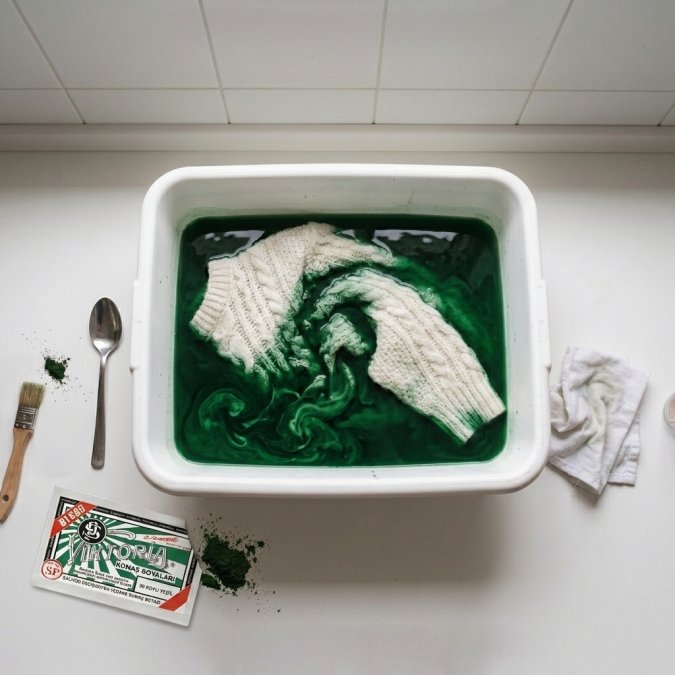
Merino wool has fibers between 17 and 24 microns in diameter, much finer than coarse wool (which is over 30 microns). Fine fibers absorb color more quickly and deeply: if you follow the soaking times indicated for standard wool, the color will be more intense than expected, often by two or three shades. Reduce soaking times by about a third and check the color every five minutes. Lambswool and Shetland wool, with intermediate fibers, follow the standard soaking times. Recycled or regenerated wool, which has already been treated, may absorb color unevenly: in this case, a longer soak at a constant temperature and without agitation is recommended.
The operating rules that really matter:
- Maintain the same temperature from start to finish, between 30°C and 40°C. Never immerse in hot water and rinse in cold water.
- Don't shake the garment: mechanical friction is the primary cause of felting. Move the garment only to soak it, then leave it still.
- Use a dye specifically designed for protein fibers . Universal cotton products have pH and temperature formulations designed for cellulose, not keratin.
- Add a fixative in the final rinse to improve hold, but only if the garment has been thoroughly rinsed: the fixative will not work on dye residue.
- Dry flat in the shade, without twisting. Hang the wet garment on a hanger and the wool will stretch under its own weight.
A step that generic instructions almost always omit: the pre-dye bath. Before applying the dye, soak the garment in warm water (30°C) with a teaspoon of non-enzymatic detergent for ten minutes. This opens the scales evenly and removes residue that would prevent the dye from adhering evenly. Without this step, the dye will set in patches, especially on garments that have been washed frequently.
Pay attention to the final rinse as well: it should be done with water at the same temperature as the dye bath, gradually adding cooler water only at the end, never all at once. Rinsing too quickly is the most common cause of felting on a recently dyed garment.
Academic research confirms that wool regeneration is now a major focus in the industry. According to a study on wool valorization published by Florence University Press in 2025, the focus on sustainability and creative reuse of wool fiber is steadily growing. Restoring color to a garment instead of replacing it is part of this trend, and doing so with the right method prevents a recoverable sweater from becoming a felted and unusable garment.
Frequently Asked Questions
Why do wool clothes lose color during washing?
Wool is a protein fiber: its scales absorb and release dyes more easily than synthetic fibers. Hot L opens the scales and releases the pigment, friction in the washing machine wears the surface, and harsh detergents dissolve the dye. Hand washing with warm water and a gentle detergent reduces the problem, and a fixative in the final rinse helps retain the color longer.
How do you fix wool colors with vinegar?
L is a useful home remedy for natural dyes, not for industrial dyes that have already been set. Adding a maximum of 100 ml of vinegar to a basin of cold water during the final rinse helps remove soap residue and slightly close the fiber scales. Don't expect a miracle effect: for garments washed frequently or exposed to the sun, a specific fixing agent like Fiske by Aybel, 100 ml per 1-1.5 kg of fabric, provides longer-lasting results.
How to revive the colors of faded clothes without buying new ones?
You can restore color with a fabric dye suitable for wool, preferably applied by hand to control the temperature. Start with a delicate wash at 30°C, then immerse the garment in a basin of dye and warm water, stir gently for 30-40 minutes, and rinse in cold water. Add a fixative in the final step and dry in the shade. This way, you avoid buying a new item and extend the life of your favorite sweater.
Which detergents should I use to avoid ruining the color of wool?
Choose non-enzymatic detergents formulated for wool and silk with a neutral pH. Proteolytic enzymes attack the fiber's keratin and promote dullness and felting. Also avoid fabric softeners and bleaches: fabric softeners leave residues that alter the fabric's pH and reduce dye retention. For home-dyed items, add a fixative to the final rinse or to the fabric softener compartment of the washing machine, following the dosage instructions on the package.